Broadband Radio Access and Backhaul Communications
Part of the Communication Technologies Division research efforts are oriented towards physical (PHY) layer design, implementation and validation of transmitter and receiver schemes or architectures, and signal processing techniques/algorithms improving the features of highly valuable when transferred to the industry. As an intermediate necessary step, the lab provides a suitable workspace and tools for prototyping and validating advanced PHY-layer research concepts under realistic conditions.
The Wireless Communication Lab is equipped with several HW instruments and COTS boards and SW tools for mixed-domain and multiple-purpose testing, troubleshooting and validation:
- Standard compliant signal creation SW for numerous wireless applications: Validation & Fine tuning of CTTC designs at baseband, IF, RF and microwave frequencies.
- Digital baseband HW&SW tools to enable digital baseband generation, capture, impair, playback and emulate real world signal conditions.
- Arbitrary Waveform Generators, Vector Signal Generators and RF up converters (up to 6GHz) capable of interfacing with signal creation software, simulators, and FPGA-based development platforms.
- Compact ultra-low phase noise CW sources up to 1GHz.
- Broadband RF Noise Generators (AWGN, from 5 to 2150MHz) for BER vs SNR testing.
- Spectrum/Signal analyzers (up to 90 GHz) & multi-channel oscilloscope (up to 8 GHz, 40 Gsps) capable of interfacing with signal evaluation and simulation tools.
- Signal evaluation and PHY troubleshooting software tools. Standard compliant signal demodulation packages dedicated to numerous wireless applications.
- MIMO validation test bench through joint use of multiple vector signal generators (up to 4), RF MIMO radio channel emulator (up to 4×2 or 2×4 cfgs., 0.3-6 GHz operation, 65 MHz BW), and 4CH digital oscilloscope.
The lab is also equipped with several RF, mixed-signal and baseband hardware boards that are part of the GEDOMIS® testbed and other PHY transceiver prototyping platforms for RF, microwave, and millimeter wave (mm-wave) radio systems such as the SHAPER digital linearization platform, being both designed, upgraded and maintained by the PHYCOM department at CTTC. Some of these assets follow:
- Ultra-high-performance 4-CH 20 to 3000 MHz reconfigurable RF downconverter (up to 80 MHz BW, phase coherent operation).
- cPCI development platform to help develop and test DSP algorithms (designed around two clusters of one Virtex-4 LX FPGA and two TMS320C6416 DSPs) including a complete board software development kit. High-speed, multi-channel data acquisition and digital-to-analog conversion platforms equipped with up to eight phase-synchronous ADCs and DACs (4-dual), with independent software-programmable VGAs, hosting high-capacity Virtex-4 LX FPGAs.
- uTCA SDR transceiver development platform including 2×2 MIMO multimode 0.3-3 GHz zero-IF radio transceivers (with selectable 1.5-28 MHz bandwidth) and Virtex-6 SX FPGA Advanced Mezzanine Card with a complete board software development kit.
- SDR and GNU Radio rapid prototyping platforms including 0.5-2.2 GHz zero-IF radio transceiver (up to 40 MHz BW) and low-end FPGAs.
- Multiple COTS evaluation modules from main vendors targeting FPGA (i.e. up to Virtex-7, Zynq-7000 and Zynq-Ultrascale+), data capture and pattern generation, D/A+IQ modulation (up to 1 GHz BW), RF direct synthesis GSPS D/A and RF sampling GSPS A/D boards, and power amplifiers and filters for sub-6 GHz applications.
- Multiple mmWave transceivers operating at E-band low and high frequency bands and components (power amplifiers, directional couplers, attenuators, waveguide to coax. adapters, etc.).
Some of the target applications are: 5G communications, advanced base stations, femtocells, smart antennas, multi-channel IF systems, beam formers, MIMO space-time coding, Software-defined radio (SDR), cognitive radio, wireless applications (modems, OFDM antenna diversity, Wi-Fi, WiMAX, 5G/LTE and FBMC transceivers, wireless backhaul equipment), power amplifier wideband digital linearizers (CFR+DPD) and real-time high-speed Test & Measurement systems.
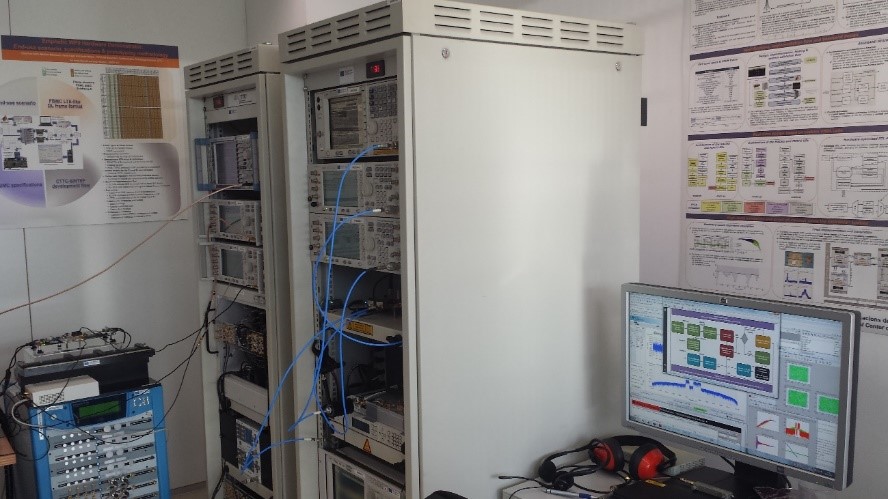
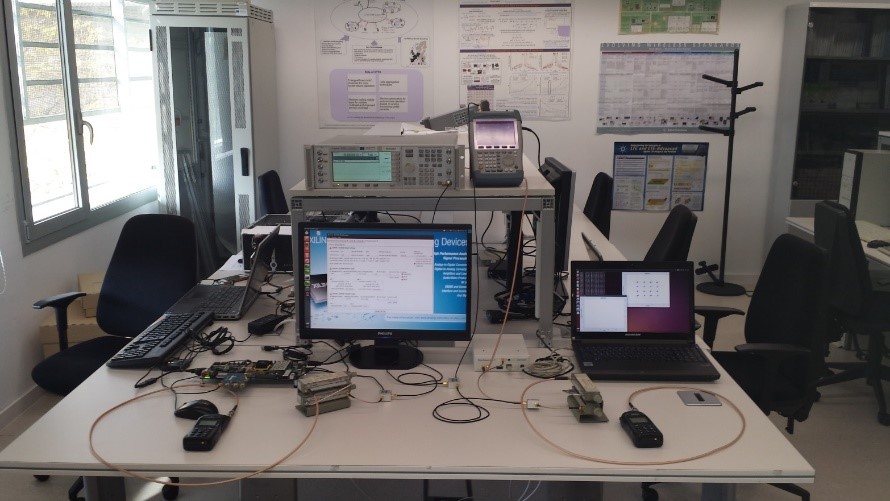
Figure 1- 4G and 5G wireless systems prototyping and validation racks, and FBMC - TETRAPOL spectrum coexistence demonstrator (right)
M2M Communications
The Wireless Communication Lab is also devoted to conduct experimental research in the area of Machine to Machine communications (M2M) for the Internet of Things (IoT) and hosts part of CTTC’s IoTWORLD®, the End-to-End (E2E) demonstration platform for the IoT. This test bed is designed and maintained by both the SMARTECH and M2M Communications departments of CTTC.
The lab provides capabilities to carry out research and development projects in a broad variety of connectivity technologies: 5G, LoRa, Sigfox, NB-IoT, Zigbee, DQ, Swap, BLE (Bluetooth Low Energy), BLE beacons, WiFi, 3G, LTE, Ethernet, and more to come.
A wide range of IoT devices are available at the Wireless Communication Lab:
- Arduinos (Yun, Due, UNO), Waspmote, Panstamp, Zolertia Z1 motes, OpenMotes, Wizzimotes, and TI Launchpad.
- Beacons: Estimote and kontackt.io
- Raspberry Pi: Zero, 3, 3B+
- Sensors: Ultrasonic, Temperature, Humidity, eHealth, Line tracker, GPS, Accelerometer.
- Actuators: DC motors, LEDs.
- Robot chassis.
- Solar Energy harvesting panels.
- Batteries and battery packs.
The lab is also equipped with powerful processing and data storage resources both to support intensive simulation processes in software, and also to explore Mobile Edge Computing (MEC), Software Defined Networking (SDN), and Network Function Virtualization (NFV), mainly targeting 5G systems. In particular, there are two sets of equipment:
- JUNO Server: a powerful computing server. Equipped with 2 Xeon Broadwell E5-2650 V4 2, 2 GHz 12 cores, 30MB cache , 128GB of memory, and 1 TB SSD Disk. It is used for simulations (NS-3, Matlab, and proprietary simulators) and also as a cloud server.
- Kubernetes Multi-platform cluster: formed by 3 Intel NUCS and a RaspberryPi3. It is intended to conduct research on the areas of MEC, SDN, and NFV for different verticals of the IoT; in particular, for the smart grid, the Industry 4.0, and connected and autonomous mobility (CAM).
Within the context of the H2020 European project 5GCAR, this experimental platform is being used to conduct experimental demos on wireless communications and MEC, applied to Connected and Autonomous Mobility (CAM), and in particular, to the connected car.


Figure 2- IoT swarm (top), device technologies (bottom left), and 5GCAR robot (bottom right).
The Wireless Communication Lab has been partially funded by the Operational European Regional Development Fund Programme Catalonia 2007-2013.
